
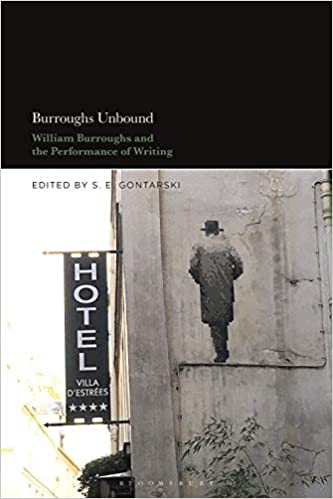
Burroughs Unbound: William S. Burroughs and the Performance of Writing
Find This Publication Online
In addition to contributing significantly to the growing field of Burroughs scholarship, Burroughs Unbound also directly engages with the growing fields of textual studies, archival research, and genetic criticism, asking crucial questions thereby about the nature of archives and their relationship to a writer's work.
These questions about the archive concern not only the literary medium. In the 1960s and 1970s Burroughs collaborated with filmmakers, sound technicians, and musicians, who helped re-contextualized his writings in other media. Burroughs Unbound examines these collaborations and explores how such multiple authorship complicates the authority of the archive as a final or complete repository of an author's work. It takes Burroughs seriously as a radical theorist and practitioner who critiqued drug laws, sexual practice, censorship, and what we today call a society of control. More broadly, his work continues to challenge our common assumptions about language, authorship, textual stability, and the archive in its broadest definition.
Reviews for Burroughs Unbound
Katharine Streip review: “This exciting collection breaks new ground for Burroughs scholarship through its emphasis on the variety and multimodal nature of his creative work.” [. . .] Gontarski “explains in the preface the need for Burroughs to be read ‘unbound,’ released from the restrictions of analyses that concentrate primarily on his well-known published writing while ignoring his abundant work in different media and the performative, rhizomatic qualities of his art. According to Gontarski, ‘Burroughs was as much a media and performance artists as he was a traditional literary figure,’ and the ‘archive’ (or ‘word hoard’ as Burroughs called drafts of his early writing) was essential for his performances (1). Gontarski recounts how the Vaduz archive almost became part of Florida State University through the efforts of Francois Bucher, medievalist and art historian, friend and supporter of Burroughs, an impressive example of an ‘unbound’ scholar to whom Gontarski dedicates his book.” Click for review and information: Journal of Beat Studies, Vol. 10 (2022): 221- 224.

From Booktopia: “In addition to contributing significantly to the growing field of Burroughs scholarship, Burroughs Unbound also directly engages with the growing fields of textual studies, archival research, and genetic criticism, asking crucial questions thereby about the nature of archives and their relationship to a writer's work.
These questions about the archive concern not only the literary medium. In the 1960s and 1970s Burroughs collaborated with filmmakers, sound technicians, and musicians, who helped re-contextualized his writings in other media. Burroughs Unbound examines these collaborations and explores how such multiple authorship complicates the authority of the archive as a final or complete repository of an author's work. It takes Burroughs seriously as a radical theorist and practitioner who critiqued drug laws, sexual practice, censorship, and what we today call a society of control. More broadly, his work continues to challenge our common assumptions about language, authorship, textual stability, and the archive in its broadest definition.” Click for review and information.
Review by Lizzy Trafford, Forum for New Writing: “In a world of surveillance and censorship, the critics in this collection delve into Burroughs’ work to consider his multidimensionality– from theorist to performer. They closely read his difficult texts to highlight Burroughs’ intricate piecing together of various sources, so that the digital and analogue technologies which produce them are given due importance. In conclusion, the text contains an excellent mixture of perspectives and creative responses to Burroughs, which will encourage further research on this enigmatic writer.” Click for review and information.

Alexander Adams review: “Overall, Burroughs Unbound gives a cross-section of current Burroughsian scholarship, extensively sourced and footnoted. The inclusion of original archival materials and transcripts makes the volume of extra interest to Burroughs fans and researchers. Burroughs’ expansive and heterogeneous published material, spreading out like a riotous and startling rhizome, is now mirrored by this expanding network of secondary scholarship, editorial commentary and publication transcripts. This is both fitting and necessary and this volume takes a primary place in that profusion.” Click for review and information.

John Shapcott review: “[F]or the general Burroughs/Beat enthusiast, the book is a welcome and valuable addition to the rapidly expanding number of studies placing Burroughs at the leading edge of contemporary literary, social and political theory.” — From Beat Scene.