
Visiting speaker Sky Hopinka introduces English department, FSU, local community to his writing, visual art, and scholarship
By Sage Moore
Florida State University students, faculty, and local community members recently gathered on a cold, winter night in downtown Tallahassee for a poetry reading from visiting writer, visual artist, and scholar Sky Hopinka.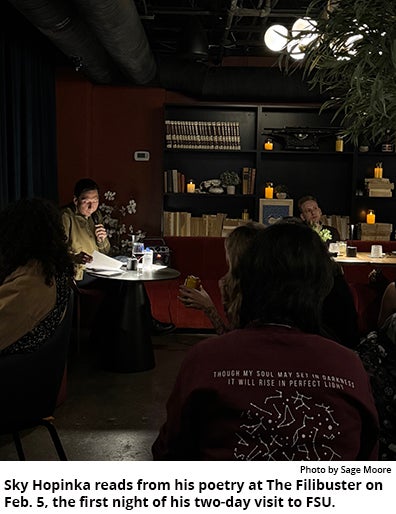
The sun had set around 6:15 that Thursday evening, so eager attendees arrived at The Filibuster after dark for the 7:30 event.
The lights were dim inside the venue’s cocktail room, adjacent to the dining area, and the music hummed at just the right volume to immerse and soothe the crowd. The space was adorned with art, books, and ambiance, intimate and cozy, comfortably housing everyone who had gathered to listen.
Hopinka described the environment as “sort of a loungy kind of place, and you could hear in the background, dishes clinking, hitting each other — that made it feel alive.”
He read his book-length poem, Perfidia, as well as poems from his new chapbook, Denizens of Hell. Hopinka finished the night off by workshopping with the crowd a new poem, one he wrote because, he said, “Sometimes you just want to write a poem that rhymes.”
* * *
Hopinka is an assistant professor in the Department of Art, Film, and Visual Studies at Harvard University as well as an award-winning filmmaker and writer. The English department’s Literature, Media, and Culture Program, with FSU’s Native American and Indigenous Studies Center and the Department of Art, cohosted Hopinka in Tallahassee for a two-day event Feb. 5-6, which featured the poetry reading, an artist’s talk, and a film screening.
The FSU Creative Writing Program presented Hopinka’s reading as a Jerome Stern Reading Series event. He gave an artist’s talk the following afternoon in the Williams Building Common Room, and later that evening, the Challenger Learning Center in downtown Tallahassee showed his 2025 documentary, Powwow People.
Hopinka’s perspective during his visit provided an opportunity for faculty and students to hear and learn from a distinguished scholar whose creativity and artistry has been recognized globally. FSU English Assistant Professor Alison Sperling, who helped organize Hopinka’s visit, introduced him at his Feb. 6 artist’s talk as “an important thinker in our moment.”
In an earlier interview, Sperling said, “Sky’s diverse practice bridges so many media, disciplines, and fields. The three events and the collaboration with FSU’s Department of Art and the Native American and Indigenous Studies Center . . . covered a wide range of approaches to scholarly and artist work that Sky's practice demonstrates exceptionally well.”
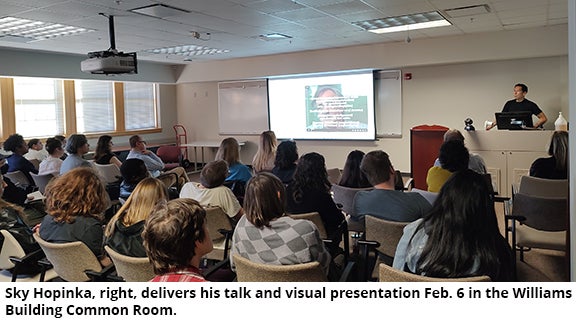 During his Friday afternoon presentation in the Common Room, Hopinka called on his past work and journey as an artist, which eventually led to him directing and editing Powwow People. The documentary had its world premiere Sept. 9, 2025, at the Toronto International Film Festival and its U.S. premiere four days later at the Camden International Film Festival in Maine.
Hopinka is a member of the Ho-Chunk Nation of Wisconsin and a descendant of the Pechanga Band of Luiseño Indians, and he gave attendees at the talk a chance to peek behind the curtain of his mind. He walked everyone back in time and reflected on his journey and how he found meaning in his writing and filmmaking.
Still and eager to soak in his personal story and scholarly knowledge, the audience seemed to be taking mental notes, sitting in a moment of togetherness, gathered to learn more about Hopinka’s background.
Hopinka spoke about his creative process as one that resists rigid structure. His work, he explained, often uses beautiful language and layered imagery to destabilize hierarchies and linear ways of thinking. Rather than offering clear or singular meanings, he approaches both his poetry and filmmaking as “ways to experience my culture,” allowing audiences to move through his work instead of arriving at a fixed conclusion.
He described his artistic practice as a process with meaning that is not simply delivered but discovered in motion. At one point, he said he prefers to “circle an idea to describe it as opposed to trying to pinpoint it.” He believes that philosophy reflects the openness, patience, and attentiveness his work asks of its viewers and readers.
* * *
Hopinka’s poetry reading the night before gave listeners the opportunity to see and feel these philosophies in action. His words were soft spoken yet demanding of the attention in the room.
His work in Perfidia, the 2020 award-winning book-length poem he read that night, in addition to his other published works, navigates an array of feelings: community, gratitude, hurt, longing, belonging, death, life, loss, love, and language itself. His reading affect was immersive, asking listeners to sit with the feeling of language as he circled its subjects.
I feel like there’s something about the space, and also how much attention goes into where [art] is presented. It’s nice when you can enter somewhere and feel that this is engulfing you in an intentional way.
— Sky Hopinka
“This felt like a good reading for me,” Hopinka said as he sat at a table in the room shortly after he finished. “I felt like I learned something from reading these different poems out loud again.”
He also reflected on the importance of engaging with live art at events like these.
“I feel like there’s something about the space, and also how much attention goes into where [art] is presented,” he said. “I think that just sets the stage of how to prepare, to receive something.
“It’s nice when you can enter somewhere and feel that this is engulfing you in an intentional way.”
In an interview before his arrival at FSU, Hopinka said that he hopes his work “invites patience and intensiveness and offers the space for forms of presence and connection that don’t always translate neatly to language.”
The coordinated efforts of FSU’s English department, the Department of Art, and the NAIS Center to showcase Hopinka’s poetry and visual arts gave audience members at his three events the opportunity to hear, witness, and be engulfed by his creativity that was both live and alive.
Sage Moore is a senior at Florida State University, majoring in English-Editing, Writing and Media, with a minor in women’s studies.
Follow the English department on Instagram; on Facebook; and on X.