
Department of English welcomes visiting speaker Sky Hopinka for two-day event to highlight Indigenous culture, poetry, film, art
By Sage Moore
The Florida State University Department of English is co-hosting a two-day event that welcomes visual artist, poet, writer, and award-winning filmmaker Sky Hopinka to Tallahassee.
Hopinka is an assistant professor in the Department of Art, Film, and Visual Studies at Harvard University, and he is a member of the Ho-Chunk Nation of Wisconsin and a descendant of the Pechanga Band of Luiseño Indians. His films have screened and received praise at festivals around the world, The Brooklyn Rail named Perfidia, his 2020 book of poetry, Best Art Book of the Year, and he earned a MacArthur Fellowship in 2022, among many other accolades.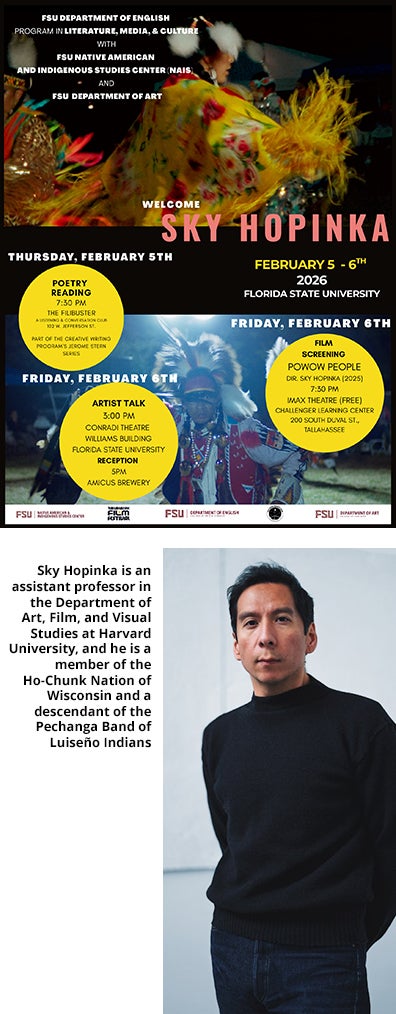
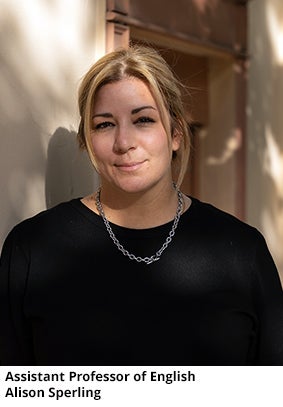
“Sky's practice bridges in lively and compelling ways a rich diversity of disciplines, fields, and media,” says FSU English Assistant Professor Alison Sperling, who helped organize Hopinka’s visit. “Just as importantly, he’s a really generous person that both faculty and students will enjoy talking to and learning from.”
His time on campus offers an opportunity for FSU and Tallahassee community members who are interested in poetry, film, Indigenous culture, and contemporary art to hear and learn from an accomplished academic.
“The three events and the collaboration with FSU’s Department of Art and the Native American and Indigenous Studies Center are meant to cover a wide range of approaches to scholarly and artistic work that Sky's practice demonstrates exceptionally well,” Sperling says.
On Thursday, Feb. 5, at 7:30 p.m., Hopinka will give a poetry reading at The Filibuster in downtown Tallahassee, as part of the Creative Writing Program’s Jerome Stern Reading Series. He then delivers an artist’s talk on Friday afternoon at 3 in Conradi Theatre on FSU’s campus, followed by a reception at Amicus Brewery.
The Challenger Learning Center in downtown Tallahassee hosts Hopinka later that night at 7:30 for a screening of his film Powwow People. The film grew out of years spent with friends and community, Hopinka says, shaped by what he describes as “showing up without a clear plan and letting the rhythms of powwow life” show through “moments of waiting, joking, drifting, returning.”
“I wasn’t interested in making something explanatory or representative in a broad way,” he adds. “A lot of the work comes from listening and from allowing things to unfold rather than trying to pin them down.”
Rather than explaining or representing powwow culture in a didactic way, he hopes audiences feel a sense of closeness—“like they’ve spent time with people rather than learned something about them.”
More broadly, Hopinka hopes his work encourages patience, attentiveness, and presence. He describes his creative process as slow and uncertain, often far removed from public attention. Still, he looks forward to participating in events like this one, particularly for the chance to engage with live audiences and deepen his understanding of his own work through conversation.
“Recognition is meaningful and I’m grateful for it, especially when it…opens up time and space to keep making things,” he says.
Hopinka and Sperling met while both were students at the University of Wisconsin–Milwaukee in the early 2010s, and they have remained in touch through shared interests in film, research, and teaching. Hopinka describes working with Sperling on this event as a continuation of that friendship, noting her commitment to creating a space not just for showing his work but also for conversation and reflection.
 “There’s a real care in how she thinks about context, audience, and dialogue,” he says, “and that makes the invitation feel grounded and generous.”
At UW-M, Sperling invited Hopkinka to conferences and creative practice showcases that she organized, and she continued to closely follow his evolving practice and career
“When the department's Literature, Media, and Culture Program put out the annual call for visiting speakers, I knew Sky would be an excellent person to bring,” Sperling says.
Hopinka also recently joined Sperling for her Queer Ecologies graduate seminar, where students watched his short experimental 2017 film, Dislocation Blues, based on the Dakota Access Pipeline Protests at The Standing Rock Sioux Reservation, home to the Lakota and Dakota nations, in North Dakota and South Dakota.
Sperling says campus events such as this one are valuable for people to attend.
“As scholars and aspiring scholars of the arts broadly speaking, I think it's important for our community to see a contemporary artist and thinker showcasing not just the products of his practice but also how he puts into dialogue Indigenous histories with contemporary experience and visual technologies,” she adds.
The English department is looking forward to hosting this academic blend of visual artistry, literature, and contemporary scholarship.
Sage Moore is a senior at Florida State University, majoring in English-Editing, Writing and Media, with a minor in women’s studies.
Follow the English department on Instagram; on Facebook; and on X.