
17th Digital Symposium will 'illuminate' online student projects
By Abigail Botsford, Senior Writer
The Florida State University Department of English will soon celebrate digital creativity through the 17th-annual Digital Symposium, which highlights examples of the best digital projects, writing, and research by members of the FSU community.
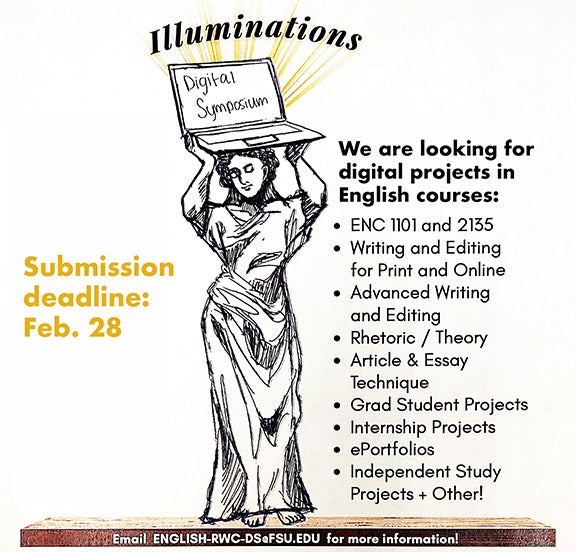
 Graduate students and undergraduate students can submit their own work for consideration, and all faculty members and teaching assistants can nominate students’ work from the 2025 spring, summer, and fall semesters. The form for nominations and submissions is currently open and accepting responses until Feb. 28.
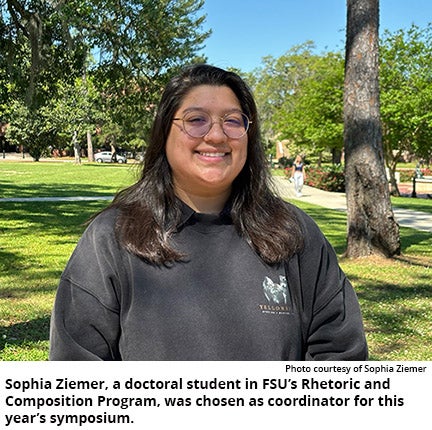
Sophia Ziemer, a doctoral student in the Rhetoric and Composition Program, was chosen as coordinator for this year’s symposium, which the Digital Studio hosts. Every year, she says, the goal is to beat the previous year’s numbers and set new records.
“This year, it would be a great honor to beat last year’s number with at least 50 submissions and nominations of student work to continue collecting and archiving exemplar student work,” Ziemer says.
The first year of this showcase was 2008, and the Digital Studio began featuring the exemplary work of students in a yearly exhibit the following year. The symposium coordinator and Digital Studio consultants create a website to display the works and host an in-person event, where students are invited to talk about their projects.
The theme of this year’s symposium is “Illuminations,” meant to consider how writing and text-production fosters creativity, specifically by using unconventional modes and mediums to illuminate learning, even when the content creator is uncertain about the greater purpose of a work.
Ziemer, who earned both her bachelor’s and master’s degrees in English at FSU, knew immediately that she wanted the theme to not just be representative of her ideas but also to embody what the project submissions from previous years have represented.
“In particular, ENC 2135 ePortfolios always explore a topic that interests the student,” Ziemer says. “Writing and Editing in Print and Online (WEPO) ePortfolios are meant to showcase their work throughout the semester. These are just two examples from previous years that are meant to end in reflection, so really the theme was meant to express how we illuminate our own learning through unconventional means like a digital portfolio, or through mind mapping, and more.”
 Ziemer explains that the theme also plays with the idea that digital means are sometimes used to illuminate learning and work through tough times, when traditional pen and paper will not cut it.
“I was originally playing with the idea of finding a light in the dark, but that felt too eerie—then it came to me… a light in the dark is provided by means of illumination,” Ziemer says. “Computer screens quite literally illuminate through light, but computers themselves can also illuminate means of learning.”
Many factors and a lot of hard work determine the Digital Symposium’s success. An engaging event depends first on the nominations and submissions: instructors in the English department are encouraged to nominate students’ work, and students and graduate students can submit completed class assignments.
“To be nominated by an instructor is a big honor,” Ziemer says. “Undergraduate students are always flattered to be nominated, but we also want students to know that they can see their own work as worthy, too. It’s more than OK for students to submit their own work for the symposium; it’s encouraged, even.”
She reiterates that participation in the symposium is open to all FSU students.
“ENC1101 and ENC2135 courses have students from every major possible, so they get to stay tied to the English department to some degree or another,” Ziemer says. “Every English instructor hopes their classes are memorable, but submitting work is a way to guarantee that their students remember the effort they put in.”
Once that process is completed, nearly the entire Digital Studio team collaborates to create the website and schedule and plan for the conference day. Ziemer emphasizes that the symposium is an opportunity for students to remember for years to come the influential work they have created in their classes. She reminds students they can add their participation as a line to their resume or curriculum vitae.
Zeimer has been working with FSU’s Reading-Writing Center since fall of 2021, her undergraduate senior year. In addition to designing the new DS logo found at the top of the Digital Studio website, she "starred" in and helped edit the campus tour video for the Reading-Writing Center in the second semester of her master's program.
She wants this year’s symposium to build upon the foundation of previous years while also pushing the event in new directions.
“I’ve seen the themes for the Digital Symposium evolve and become more complex and personal to the writing center with time,” Ziemer says. “Last year’s coordinator, Giana Nardelli, really pushed to not only bring the event back in person but also pushed to incorporate a conference element to the event.”
Last year’s theme, the 16th annual, was “Celebrating Milestones in Digital Composing,” referencing the “sweet 16” of the symposium. (Click the link to read English-Literature, Media, and Culture major Angelina Dobbs' article about the 2025 symposium.) Ziemer hopes to continue Nardelli’s vision by combining the digital site and a single-day event—tentatively planned for April 1—to highlight the work in person and to give participants from last year the chance to present their work.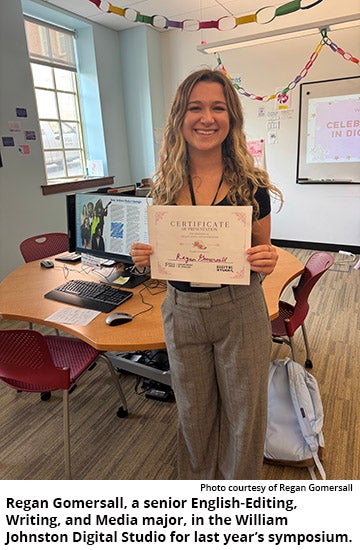
Regan Gomersall, a senior English-Editing, Writing, and Media major, is one of many students who participated in the 2025 symposium. Her WEPO instructor, Rhetoric and Composition doctoral alumnus Drew Hudnall, introduced Gomersall to the opportunity to showcase her work.
“He encouraged me to present the magazine spread that I created for a project in that class the semester prior to the symposium,” Gomersall says.
Her submission, “How Artists Make Change,” explored how musicians can use their platforms to bring about societal change.
“Musicians often use their lyrics to highlight their personal beliefs or perform at political events in support of certain causes,” says Gomersall, adding that classroom conversations regarding the literacy practices of different communities related to her minors in music and sociology and inspired her project. “I applied this concept to musicians, finding that, oftentimes, their music was used as a tool to address much larger societal issues.”
In the first semester Zeimer taught at FSU, Gomersall was a student in her ENC 2135 course.
"She was a music major at the time but switched to English," Zeimer says. "It is so sweet to see her project being highlighted."
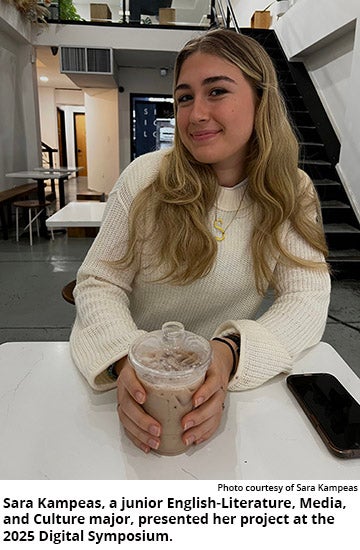 Sara Kampeas, a junior English-Literature, Media, and Culture major, also participated in last year’s symposium. Rhetoric and Composition doctoral candidate Bridgette Sanders nominated Kampeas for an essay she had reviewed as part of her class.
“It was such an honor when she nominated me, and I truly appreciated being recognized for the work I put into the project,” Kampeas says. “It meant a lot to me as a writer to have my efforts acknowledged in this way.”
Kampeas studies psychology for her minor, and she submitted a multimodal essay, "The Power of the Feminine: Redefining Stereotypes through Film."
“This project was inspired by my interest in how film reflects and reshapes societal norms, particularly those surrounding women,” she says. “It was a deeply personal exploration of how female characters are often boxed into specific stereotypes, and I wanted to challenge that narrative.”
Gomersall and Kampeas are grateful for the experience, and they agree on how rewarding it was to participate in the symposium. They offered more detail about themselves and their experiences.
What did participating in the Digital Symposium mean to you as a student and writer?
Gomersall: Participating was an incredible experience that allowed me to strengthen my presentation skills and share my work with a larger audience. It was amazing to be able to discuss my magazine spread with people attending the symposium, allowing me to see my project from others’ perspectives, viewing it in a new light. I also really appreciated that the Digital Symposium allowed me to connect with other presenters, allowing me the opportunity to learn from my peers’ projects, as well.
Kampeas: The experience was incredibly meaningful. It gave my work a second life, beyond the classroom and the typical assignment submission process. Often, when writing a paper, it feels as though all the effort and dedication put into the process fades once it’s submitted, but the symposium allowed my work to persist, making the experience uniquely rewarding. It really reignited my passion for writing and exploring ideas through different formats.
How did working in a digital or multimodal format shape the way you approached writing or storytelling in this project?
Gomersall: In creating my magazine spread, I wanted to ensure that the visual elements of the piece reflected the ideas discussed in the article’s written portion of the article. I focused on 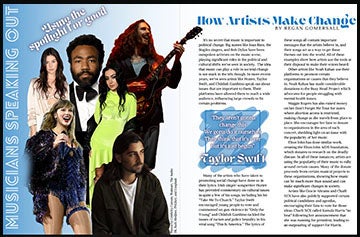 creating visuals that highlighted these musicians’ platforms and style, layering images of different artists to portray them as performers on one stage and using bright colors to highlight quotes and evoke the image of the marquees often seen outside music venues. I also thought it was important to use fonts and designs that denote different ages of music, emphasizing that musicians have been using their platform to ignite change for decades. I used a blue and white color scheme to symbolize creativity, inspiration, authority, and openness, which are all values that are important in these artists’ music. Parts of the magazine used a blue background that faded into white, which I intended to represent the change these artists are trying to spark in the world.

Kampeas: The digital and multimodal nature of the symposium was especially impactful. It shaped my approach to the project, as I incorporated visual elements to enhance my written analysis. After that experience, I applied a similar approach to another essay of mine, "Rose-Colored Glasses: A Modern Day Terministic Screen," which creatively incorporated photographs and metaphors into the paper. The ability to combine text with images allowed me to convey complex ideas in a fun way. I was able to see firsthand how different mediums can strengthen a message and resonate with the audience on multiple levels.
For more on the history of the Digital Symposium, read this 2018 article, "The FSU Digital Symposium: Origins, Revisions, and Reflections", written by FSU doctoral alumni David Bedsole, Jacob W. Craig, and Rory Lee, and published in Computers and Composition Online.
Abigail Botsford is a senior majoring in English-Editing, Writing, and Media, with a minor in communication.
Follow the English department on Instagram; on Facebook; and on X.