
Teaching in Spain helps Molly DeKraai explore a lifelong dream
By Abigail Botsford, Senior Writer
Molly DeKraai has always felt destined to live abroad. She first experienced life outside of the U.S. when she was a child and her family lived in Japan for three years.
Then, as an undergraduate student at Florida State University, she studied in Florence, Italy during the summer of 2022 through FSU’s International Programs.
Now an alumna, DeKraai has been living and working in Spain for the past two years as a language instructor through that country’s North American Language and Culture Assistants Program.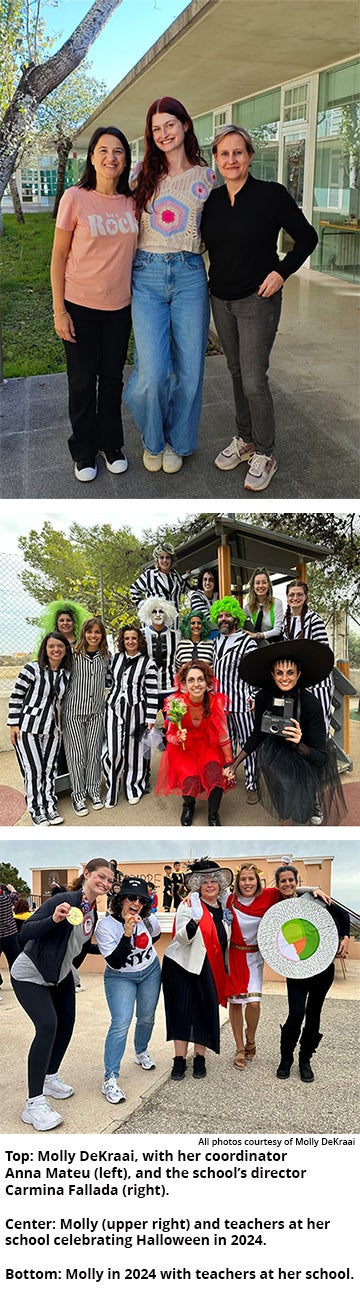
NALCAP partners American college students and graduates with elementary and secondary schools in Spain to assist with various language programs. She first learned about NALCAP from older members in her sorority who had participated in the program.
“I remember thinking that this seemed like a really cool opportunity to travel, live abroad, and see if that’s something that I can do because I was always very interested in living abroad in some capacity,” says DeKraai, who graduated from FSU in May of 2024 with a dual degree in English-Editing, Writing and Media and media communication studies.
DeKraai works as an English Language and Culture Assistant under the supervision and guidance of teachers in Spain.
“I always said I wanted to go back to Italy because I studied there in the EWM Program in the summer of 2022,” she says. “In my mind, though, I thought Spain was a similar opportunity to live abroad and travel.”
Working as an English language assistant in Spain does not require any certificate or proficiency in Spanish, only a bachelor’s degree or current enrollment as a second year or higher in college. This provides an easy opportunity to work and live in Spain.
“It’s the path of least resistance, which isn’t a very glamorous answer,” DeKraai says, “but I’m super happy that it is the path that I ended up taking, because now I never want to leave.”
The NALCAP application process is relatively simple as well. Applicants submit a college transcript, a copy of their passport, a letter of recommendation, and a personal statement. DeKraai applied and was accepted to start her position in the fall of 2024.
“You wanted to be one of the first people to do it, so timing mattered,” she says. “It was almost a guarantee that you would get a position, and most likely with the first region that you chose, because you’re able to rank three regions, and there are different tiers.”
DeKraai spent her first year with NALCAP, beginning in October 2024, in Alicante, in the Valencian Community, at a rural elementary school.
“I loved working in a really small school, because I knew all of my kids by name, and I was able to take the time to get to know all of them,” DeKraai says. “I worked with one English teacher—the entire school had one English teacher. So, we spent all day, every day, together.”
Her first year of teaching ended in May 2025. After a three-month break spent at her home in Herndon, Virginia, DeKraai returned to Spain in October 2025. For her second year with NALCAP, she is a language assistant at a large high school in Tarragona, a city in Catalonia.
Teaching at a high school has been a completely different experience for her.
“I work with a ton of different teachers—I’m in geography class, art class, science class. That’s been super interesting, just to appreciate the differences and the lessons that I’ve learned,” DeKraai says. “I think it’s so important to meet the students where they are, because I’m here to teach them English.”
Just as her experiences have differed depending on the school, so has her schedule. DeKraai has always worked on Tuesday, Wednesday, and Thursday, but her responsibilities throughout the day have changed.
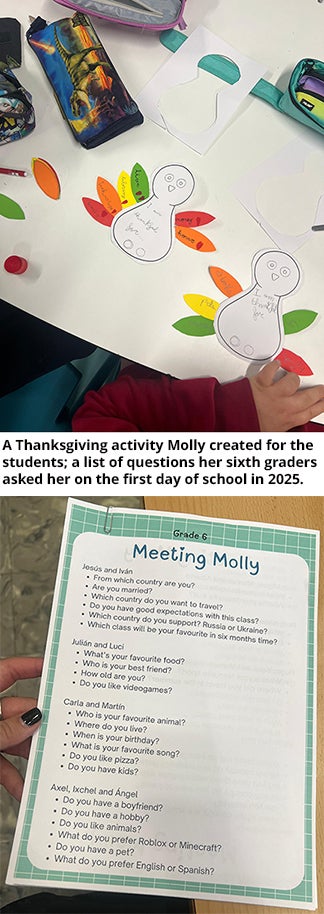 “Last year, I was just in English class all day, and I had a set schedule, and I would go to every grade, first through six, twice a week,” DeKraai explains. “This year I have a theater class, where we do little plays in English. Then I go to science class, social studies—where I go depends on the day.”
As a language assistant, DeKraai works in small groups with her students to practice conversational English, collaborates with department colleagues to create projects, and designs presentations for students based on American culture. In turn, DeKraai learns more about Spanish culture from her students.
When she is not at the school, DeKraai takes time to immerse herself in the culture by attending festivals, parties, and other events.
“One thing about the Spanish is that they’re going to party and they’re going to have the most random festivals you’ve ever heard of,” DeKraai says. “And that is one of my favorite parts about living in Spain. Last year, my best friend lived in a small town, about 45 minutes north of Alicante, and anytime I would visit, there was something insane going on.
“I’m now tight with a marching band from this random Spanish town, because every time I went, they were having, like, a full fiesta,” she adds.
She recently attended Festa de la Calçotada in Valls, near Tarragona. The annual winter festival celebrates calçots, a mild, green onion grilled over hot coals, and she witnessed an onion-eating contest, where a man ate 109 onions in one hour.
Living in both Alicante and Tarragona has shown DeKraai how proud the citizens are of their beautiful and culturally rich areas. DeKraai has also experienced firsthand the differences that distinguish the two places.
“In the Valencian Community, they speak Valencian, and in Catalonia, they speak Catalan,” DeKraai says. “They’re not the same, but they are very similar.”
Settling abroad can be challenging at first. When DeKraai arrives in Spain, she has to find her apartment, open a bank account, and visit the local police station to receive an identity card. Alicante is a moderately sized city, with approximately 360,000 residents. Tarragona’s population is about 143,000 people.
“I can imagine if you live in Madrid or Barcelona, finding a time to get an appointment is probably more difficult, but this year, it was super easy,” DeKraai says. “I went to the police station and showed them my passport and my documents.”
DeKraai adds that living abroad has taught her to be more independent and proved that she can live and function in a foreign country.
“You have to find an apartment no matter where you are,” DeKraai says. “It’s a different experience here, and maybe you have to use Google Translate to talk to people, but that’s life.”
Olivia Webb, who also works as a language and culture assistant for NALCAP, has been DeKraai’s roommate in Spain for the past two years.
“I truly hit the jackpot with Molly as my roommate,” says Webb, who earned a dual degree in international relations and Hispanic 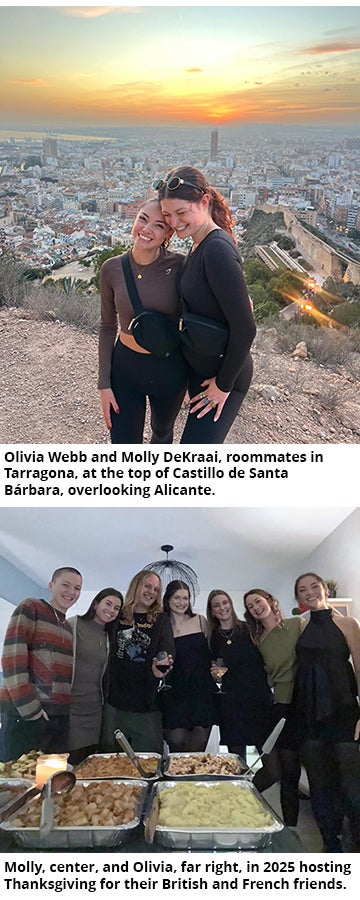 studies from the College of William & Mary in Williamsburg, Virginia. “Living abroad always has its ups and downs and it’s great to know we are experiencing the same challenges together and supporting each other throughout it all. Going through this experience with Molly has shown me her resilience, confidence, and optimism.”
Being an English major at FSU has been helpful for DeKraai, and that knowledge and her interest in the English language factors into succeeding in her current role as an English Language Assistant.
“I think I find it easier than some of my other friends,” DeKraai says. “When I’m explaining a certain concept, especially at the high school, I’ve noticed this is a big difference and it’s much easier. Because of how much I studied English in college, I’m able to draw the parallels between a concept in Spanish that makes sense, and I can draw the parallel there for them.”
DeKraai also finds that her interest in language in general is beneficial as she navigates life in Spain and engages with the country’s culture.
“When I first got here, I couldn’t talk to anyone, and I was uncomfortable, so I immediately started going to Spanish classes twice a week,” DeKraai says. “My desire to communicate with people, because of how important that is, really lit a fire under my butt. I thought, ‘How can I expect people to learn English from me, and I don’t even speak Spanish?’”
Living and putting down professional roots in Spain quickly became a possibility for DeKraai early in her time in the country.
“I think that is something you can only really decide after truly living somewhere,” she says. “I am so lucky that this program exists and is giving me the opportunity to live here and to make that informed choice.”
Even though finding a job in Spain as a foreigner can be difficult, DeKraai’s experience with NALCAP has opened her mind to the idea that she now has options.
“I never thought I was going to be a teacher, but here I am,” DeKraai says. “So, what are other things that I never thought I was going to do?”
Her advice to anyone interested in teaching, working, or even just traveling abroad is to do it: “Be smart, be responsible, but this is the one time in your life that you are in complete control of everything,” she says.
For DeKraai, she says this experience in many ways is fulfilling her destiny: “It is genuinely the best thing that I think I’ll probably ever do.”
Abigail Botsford is a senior majoring in English-Editing, Writing, and Media, with a minor in communication.
Follow the English department on Instagram; on Facebook; and on X.