
REFLECTING ON 70+ COLLOQUIES
W, Apr 29 ’026
by Dennis Moore
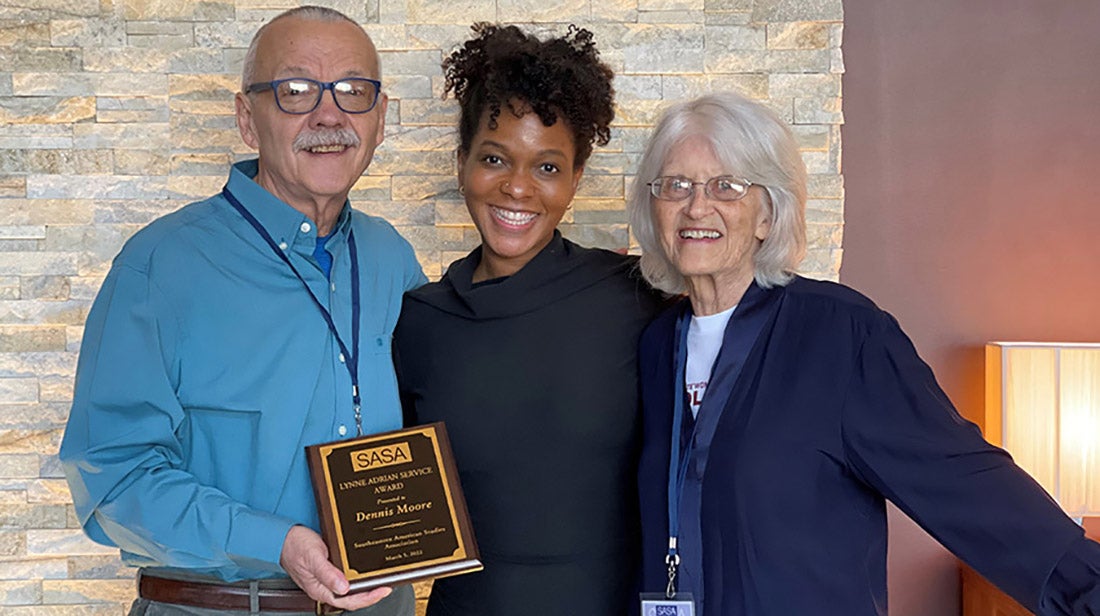
Recently I’ve updated the list of interdisciplinary colloquies that I’ve organized and frequently chaired, beginning in the mid-1990s, at conferences of the American Studies Association and several A.S.A.-adjacent organizations, including the Society of Early Americanists (I’ve also provided a version of these notes to the SEA for their newsletter, where there’s a paywall). The list includes the panel last March on Kathleen DuVal’s Pulitzer- and Bancroft-winning Native Nations: A Millennium in North America, at the biennial conference of the Southeastern American Studies Association, as well as the roundtable I’m cooking up for the next SASA conference, next March, on distinguished historian Marcus Rediker’s Freedom Ship: The Uncharted History of Escaping Slavery by Sea. His earlier book The Slave Ship had been the focus of a colloquy in 2009, at the first biennial conference the SEA staged outside North America, at Hamilton, Bermuda, and I quote here from his recent e-mail:
Dear Dennis,
I had no idea that you’ve done 70+ colloquy-with-the-author sessions. Congratulations!
I’ll just say that my book The Slave Ship: A Human History has received a lot of reviews and discussion over the past nineteen years, but never deeper nor better than in the session you organized in 2009. Thank you.
It’s worth noting here that in 2010 the journal Atlantic Studies published a lengthy cover piece on that colloquy and that print follow-ups to other roundtables on this list have appeared in the William and Mary Quarterly, New England Quarterly, Studies in Eighteenth-Century Culture and commonplace.org as well as in Early American Literature’s special 2012 issue, “Between Literature and History.”
Another recent response came from Shelley Fisher Fishkin, who participated in both the colloquies recognizing the value of the late Annette Kolodny’s scholarship. Each was at an American Studies Association conference: the one in 1998 focused on her Failing the Future: A Dean Looks at Higher Education in the Twenty-First Century, and the focus 16 years later was on her In Search of First Contact. Now, quoting here from that recent e-mail:
Dear Dennis,
It was a pleasure and a privilege to participate in your colloquy-with-the-author session with Annette Kolodny on her book, In Search of First Contact: the Vikings of Vinland, the Peoples of the Dawnland, and the Anglo-American Anxiety of Discovery. It was a memorable conversation that introduced many who had not read her book to the provocative and important ideas she explored, and the multiple perspectives from the panelists deepened the understanding of those who had read the book. I know the event meant the world to Annette, someone who was a pioneer in foregrounding both feminist and indigenous issues in American Studies. She had never really gotten the attention she deserved for her ground-breaking and paradigm-shifting research throughout her career, and your panel allowed more junior scholars like myself to give credit where credit was due. Thank you for organizing it!
Other than the late Annette Kolodny, the only scholar to have two books on this list is Elizabeth Maddock Dillon, who received the Barnard Hewitt Award for Outstanding Research in Theatre History in 2015 as well as a Finalist Mention for the 1915 John Hope Franklin Prize for her New World Drama. Her earlier book, The Gender of Freedom: Fictions of Liberalism and the Literary Public Sphere, was the focus of a plenary session at the SEA’s joint conference in 2007, at Williamsburg and Jamestown, with the Omohundro Institute of Early American History and Culture.
Frances Smith Foster’s ’Til Death and Distance Do Us Part: Love and Marriage in African America was the focus of a colloquy at the SEA’s “Triumph in My Song: Eighteenth-and Nineteenth-Century African Atlantic Culture, History and Performance” conference in 2012 at the University of Maryland. More recently, she responded to these colloquies like so:
Generally, I pour heart and mind into a project only to hear the sound of silence. The conversation around my book was a dream come true. It didn’t hurt that they liked it, but the true pleasure was knowing they read it and gave me the gift of informed critique. It was the intellectual exchange I had dreamed the academy provided but in reality I had never found before—or after!
While almost all these roundtables in the first two decades of this century focused on slavery, several focused on indigenous culture: Joanna Brooks’ American Lazarus: Religion and the Rise of African American and Native American Literatures, at the A.S.A. conference in 2006, and three at American Society for Eighteenth-Century Studies conferences: Laura Stevens’ The Poor Indians: British Missionaries, Native Americans and Colonial Sensibility in 2008, Matt Cohen’s The Networked Wilderness in 2011, and Hilary Wyss’s English Letters and Indian Literacies: Reading, Writing, and New England Missionary Schools, 1750-1830 in 2015. Still other colloquies on books dealing primarily with slavery included ones with Vin Carretta on Equiano the African: Biography of a Self-Made Man in 2007; with Stephanie Smallwood in 2009 on Saltwater Slavery; with Annette Gordon-Reed on The Hemingses of Monticello, at the SEA’s 2011 conference; and with Ramesh Mallipeddi in 2018 on Spectacular Slavery: Witnessing Slavery in the Eighteenth-Century British Atlantic. Brigitte Fielder, a participant in the colloquy in 2015 on Ed Baptist’s The Half Has Never Been Told: Slavery and the Making of American Capitalism, commented recently:
I always loved the colloquy-with-the-author sessions because they both give folks a chance to engage deeply with an extended piece of scholarship and prompt a conversation that inevitably pushes this engagement forward, toward new directions. They were super helpful for thinking about how and in what contexts one might cite texts, but also how we might teach with them.
Another prominent pattern involves award-winning books. Like Kathleen DuVal most recently, Eric Foner received both a Pulitzer and a Bancroft, for The Fiery Trial, and Annette Gordon-Reed received a Pulitzer for The Hemingses of Monticello, for which she also received a National Book Award. Like DuVal, Lisa Brooks also received a Bancroft, for Our Beloved Kin, and the colloquy on that book was the first of these panels to be virtual, thanks to the pandemic. Recipients of the Early American Literature Book Prize have included Anna Brickhouse for The Unsettlement of America—for which she also received the Modern Language Association’s James Russell Lowell Prize and was one of two finalists for the American Studies Association’s 1915 John Hope Franklin Prize for the year’s best book in American studies--as well as Caroline Wigginton for In the Neighborhood: Women’s Publication in Early America, Robert L. Gunn for Ethnology and Empire (colloquy at the Modern Language Association conference in 2018), Wendy Roberts for Awakening Verse, and Lindsay DiCuirci for Colonial Revivals: The Nineteenth Century Lives of Early American Books, which also received the 2020 First Book Award from the Library Company of Philadelphia. Joanna Brooks received the Modern Language Association’s William Sanders Scarborough Prize for American Lazarus, and this colloquy at ASECS’s 2016 conference featured a pair of books: Russ Castronovo’s Propaganda 1776 and William Beatty Warner’s Protocols of Liberty, recipient of ASECS’s Gottschalk Prize.
Two other responses to the updated list of these colloquies came from colleagues who had participated in conferences I was unable to attend. Ralph Bauer received the Modern Language Association’s Aldo and Jeanne Scaglione Prize for Comparative Literature for his The Alchemy of Conquest. I’m grateful that Peter Reed graciously agreed to chair the roundtable on that especially impressive book at the A.S.A.’s 2021 conference in San Juan, Puerto Rico. Here is Ralph’s recent comment about these colloquies—
Over the years, these sessions have grown into an institution and fixture not only at the SEA biennials but also at the conferences of adjacent organizations, including ASECS and ASA. They have provided important opportunities for critical and friendly engagement with recent publications in our field and hereby given authors much welcome recognition of their accomplishment and the unique opportunity for reflection on their work. I hope that these sessions will continue to be part of all conferences in our field.
—and here’s the comment I recently received from Theresa Gaul, who had been especially helpful in cooking up the roundtable at the SEA’s June 2023 conference on Wendy Roberts’ book Awakening Verse:
Over the years, the book colloquies that Dennis Moore has organized have been an important marker of significant work in the field. Even when I haven’t been able to attend the session and/or conference, I paid attention to which book he selected and added it to my reading list. In addition, Dennis’s work has facilitated publications, as when the panelists discussing Wendy Roberts’ Awakening Verse went on to publish our responses as a roundtable in New England Quarterly in 2024. I suspect there are additional publications resulting from the colloquies we don’t even know about, and in this way, the discussion encouraged by the sessions has served as a fertile ground for prompting new scholarship. A generous and rigorously conceptualized contribution to our field, Dennis’s consistent organization of the colloquies has made them a distinctive and memorable feature of conferences.
On that note I close,
Looking forward,