
Digital Symposium coordinators, planners create 'living' museum and archive for student presenters to showcase online projects
By Sage Moore
Florida State University’s Digital Studio recently hosted the 17th-annual Digital Symposium. Each year, the event showcases an array of digital projects created by English graduate and undergraduate students, highlighting the work they accomplished throughout the school year.
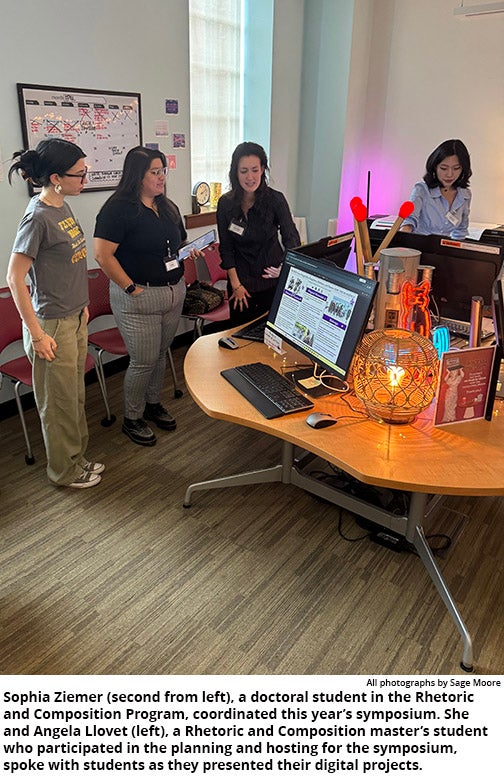 Sophia Ziemer, a doctoral student in the Rhetoric and Composition Program, was the coordinator for this year’s symposium, which she says offers English majors a showcase for the more creative, digital work they do.
Ziemer, who earned both her bachelor’s and master’s degrees in English at FSU, coined this year’s theme of “Illuminations.” She explains that idea highlights how learning and meaning-making can occur when creativity and multi-modality converge at a digital intersection.
“I was originally playing with the idea of finding a light in the dark, but that felt too eerie—then it came to me… a light in the dark is provided by means of illumination,” Ziemer said in an interview in late February 2026. “Computer screens quite literally illuminate through light, but computers themselves can also illuminate means of learning.”
Students who submitted their digital compositions now have their projects showcased via the Digital Symposium’s website, which acts as a “living” museum and archive. Several students also presented their work during an April 8, 2026, in-person event in the William Johnston Digital Studio.
Application requirements for the symposium specified that projects needed to be digital and had to be created within a course offered in the English department. Students submitted e-Portfolios, magazine spreads, audio and video compositions, multigenre and multimodal essays, and digital artifacts.
Not only is this an opportunity for students to from different academic programs to think critically about rhetorical design choices and creative projects, but the symposium also is an opportunity to have their work seen outside of classrooms.
Students gathered and communed to present their work via digital exhibitions throughout the day in the Digital Studio. After a hiatus during and post-pandemic, this is the second year in a row the in-person element was in place.
“I love any opportunity where we can get students from the different programs together,” said Kamila Albert, specialized faculty in the Department of English and the director of the Reading-Writing Center and Digital Studio. “From creative writing, editing, writing, and media, literature, there are not many places where we see those students talking about their work together in one place.”
The in-person gathering in the Digital Studio artistically brought the theme to life. The room was intentionally dimly lit and cozy, with curated lamps and soft ambient lighting that illuminated and created an intimate, tight-knit feel. The digital displays on the studio’s many desktop computers shone brightly throughout the room to display the student creations.
And there was pizza and cookies.
Ziemer says the months of planning was a team effort and labor of love.
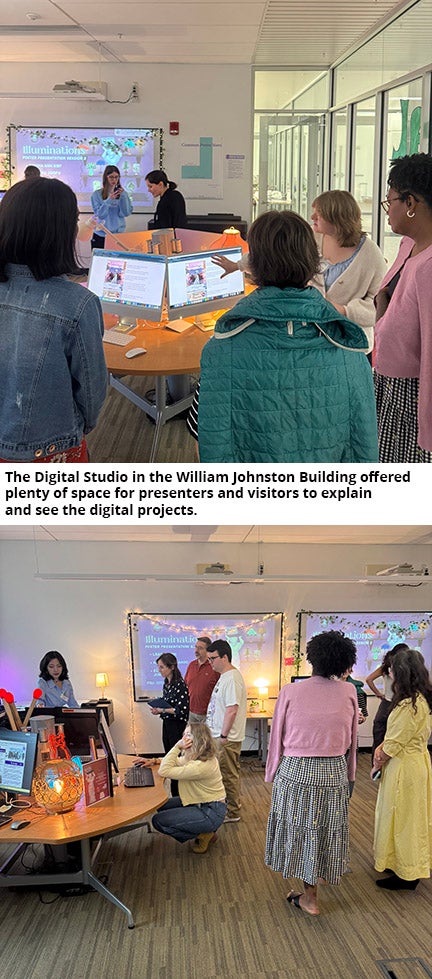 “It’s really like a machine, and all of us in here are just cogs,” Ziemer said, as she took a short break to talk about the symposium. “None of this is possible without the rest of the team.”
Visitors to the Digital Studio could feel the care put into every detail, from the thoughtful curation of theme and decor to the hand-drawn poster that took the team weeks to create. Even the decision to highlight the previous symposium websites was a deliberate one.
“One of the things that we made sure to do was to keep the websites alive,” Ziemer noted, “as an archive that is accessible forever.”
This small act showed that students can continue learning from the symposium and allowed past participants to look back at their published work. Albert is a doctoral graduate of the Rhetoric and Composition Program and has been RWC-DS director since 2021, and she has watched the event evolve over time.
“We have seen it expand from a much smaller event for the first 10 or so years, held in a small meeting room connected to the Writing Center,” she recalled, referring to the early years of this showcase. “It was fairly contained, mostly for our department. Within the last two to three years, we have really wanted to make it more of a university event.”
She added that the growth feels right: “I do feel like our efforts are paying off.”
The thread running through all the projects, Albert said, is student creativity outside the traditional written essay format.
“The projects themselves are very different,” she said, “but the [connection] is the way that we come together, think critically about the projects, and ask about the creative process behind building them, about the rhetorical design of it all.”
One goal she had was for visitors to leave with “a better understanding of multimodality, rhetorical design” and new inspiration. Most of all, she appreciated the rare chance to bring together students from across disciplines.
“We share a lot of the same values, and so to get us all together in a room, just talking about our work, I feel like there’s a great sense of camaraderie,” she said.
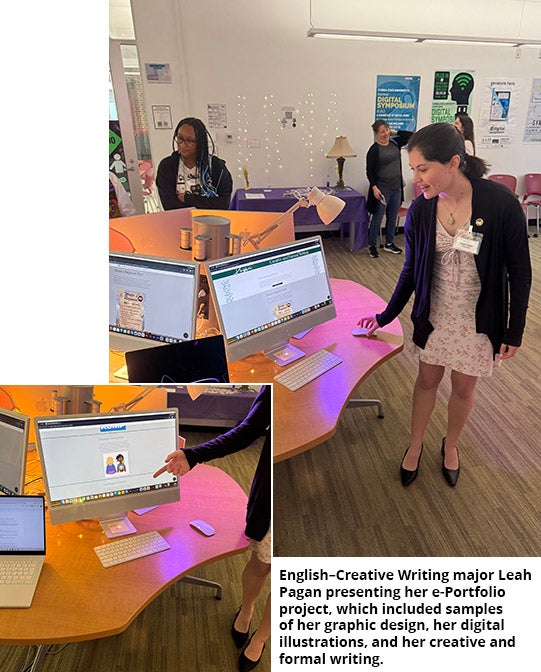
Leah Pagan, an English–Creative Writing major and undergraduate participant whose work was showcased, captured the value of the process perfectly.
“The projects themselves, as well as their curation into a total body of work with a uniting theme, are labors of love,” she said, as she sat in the Digital Studio waiting to present her e-Portfolio. “They are markers of students’ growth, both academically and professionally, that will live on forever in the digital exhibition.”
She especially enjoyed the collaborative spirit between presenters and the coordinators.
 “In terms of working with the symposium, I found that I connected with other creatives who are passionate about design,” she said. “Fellow presenters were so willing to share feedback and encouragement with each other. The Digital Studio staff also provided constructive feedback before the release of the exhibition to make our works even stronger.”
As Pagan showed her work to attendees, the rhetorical choices and storytelling skill behind the digital pieces were on full display. She articulated the details and brought the audience into her creative process, design decisions, and the narrative her work told.
Angela Llovet, a master’s student in Rhetoric and Composition, participated in planning and hosting this year’s symposium. She echoed others regarding the opportunity’s appeal, saying the symposium is “a great way to showcase any digital project created in an English course. Everyone should apply. I regret not applying as an undergraduate.” Instructors from any course taught in the English department can also nominate student projects.
At its core, the symposium is rooted in rhetorical design. Angela Llovet, a master’s student in Rhetoric and Composition, participated in planning and hosting this year’s symposium. She echoed others regarding the opportunity’s appeal, saying the symposium is a “good way to showcase any digital project. You should apply. I regret not applying as an undergraduate.”
“What are the choices you would make for certain audiences? That is the basis of it,” Ziemer explained. “The aesthetics come afterwards.”
All 75 published projects, she added, showed the “heart and thought” poured into each one.
Visit the Digital Symposium website to explore all the submissions from this year’s event. Video discussions with several of the presenters are posted on the FSU Writing Center & Digital Studio Instagram page.
Sage Moore graduated from Florida State University at the end of the Spring 2026 semester with her bachelor's degree in English-Editing, Writing, and Media, and a minor in women’s studies.
Follow the English department on Instagram; on Facebook; and on X.