
Department played integral role in bringing a Humanities Center to FSU's campus; English students earn prestigious fellowships
By Noah Garry
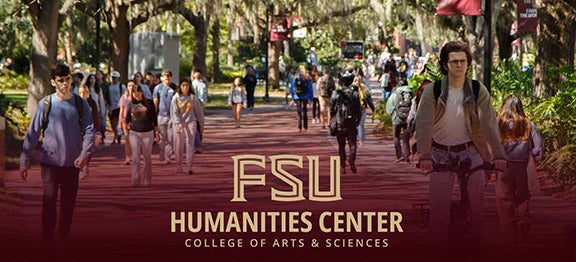
Florida State University's College of Arts and Sciences has launched an on-campus Humanities Center to be a hub of interdisciplinary collaboration across multiple academic departments, and the Department of English played a pivotal role in forming the new center.
"English was in the room from day one," says Frances Cushing Ervin Professor of English Aaron Jaffe, who serves on the advisory board.
Many other major universities have long had a humanities center, a key factor for FSU to establish its own.
"English has wanted a humanities center for a long time, and so have I," says Jaffe, who served on the steering committee with English Associate Professor Tarez Samra Graban, alongside colleagues from the collaborating departments and programs. “Our peers all had them, and they’re magnets for top faculty, students, and resources.”
The center’s 10 affiliates include seven departments in the College of Arts and Sciences, one department and one program in the College of Fine Arts, and one program in the College of Music. Faculty members in the English department have been key in keeping the center’s creation and future in the university’s plans.
As a member of the advisory board, Jaffe has high expectations for the center, in general, and what the new resources mean specifically for the department.
"English has always been a place for interdisciplinary thinking,” he says. “But we need more visible ways for undergraduates, graduate students and professors to share ideas and partner with other humanities people."
FSU’s Professor of Religion and History John Corrigan is the center’s founding director.
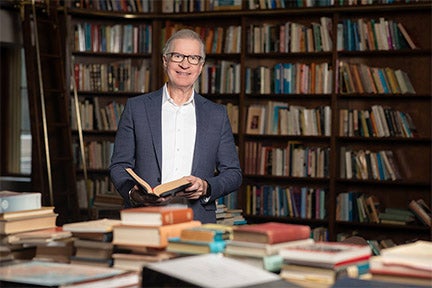
“The Humanities Center rests on the premise that good things happen when people from different disciplines share their ideas about what it means to be human,” Corrigan said in a recent College of Arts and Sciences article. “Our vision is to create a place where researchers in the humanities at FSU, as well as the public, can engage in interdisciplinary conversation and equally find ways to strengthen their expertise in their areas of study.”
Jaffe says the advisory board is “lucky to have Dr. Corrigan at the helm.”
"He brings the scholarly range, the energy, and the vision to make the FSU Humanities Center something special," Jaffe adds.
The Center is implementing a wide range of efforts to promote professional development and thought collaboration, as well as to establish connections through its partnerships with FSU’s cultural, social, and governmental organizations. The goal is to support scholars across all levels of academia—from faculty members to undergraduate students—following a central theme that will run on a two-year cycle, providing a cohesive vision.
The theme for 2026-2027 is “The Human in the Humanities,” which “explores what it means to be human amid the rise of artificial intelligence and the discoveries of neuroscience and genetics, and what ethical behavior and the ‘good life’ look like in this new technological era,” according to the news article.
This is a chance to share work and meet people across campus. The center will backstop a stimulating humanities research culture, one that serves an intellectually curious, engaged student body, directly and indirectly.
— Professor Aaron Jaffe
Not only will the center exist as a central hub to “engage in interdisciplinary conversation,” as Corrigan stated, but numerous events and meetings also will be held to facilitate that productive collaboration, including symposia, conferences, and reading groups. Having a physical space on campus is also in the works.
One of the more important aspects of the center, Jaffe says, is the board’s dedication to provide support for all levels of academia, with resources intended to suit the needs of the entire campus community.
“For faculty, there will be research support, working groups, visiting speakers, and spaces to test ideas,” Jaffe says. “For graduate and undergraduate students, the same is true: This is a chance to share work and meet people across campus. The center will backstop a stimulating humanities research culture, one that serves an intellectually curious, engaged student body, directly and indirectly."
In addition to efforts to assist students in their professional and academic development, the center also welcomed eight Humanities Center Dissertation Fellows for 2026-28. Megharaj Adhikari, an English doctoral candidate in literature, media, and culture, is a member of the inaugural class.
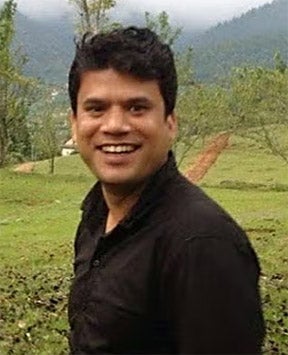
“As a fellow, I can offer colleagues a literary archive and a practice of close reading that turns abstract debates about the posthuman into specific, shared objects of discussion,” says Adhikari. “I applied for the fellowship because I believe scholarship grows through exchange, and the Center offers a community of scholars from many disciplines who test their ideas against one another.”
Adhikari’s dissertation project, directed by Jaffe, is titled “Peak Modernism,” and the research studies “how modernist writing measures existence through mountains, elements, and planetary depth, drawing on posthumanist and elemental media theory to reorient the human within a larger planetary order,” Adhikari says.
“The scholars are committed to working through what the humanities become when the human is no longer their unquestioned center, the same question that I am addressing in my dissertation,” Jaffe says. “Their questions will, in turn, widen the stakes of my dissertation, and together we can build a vision of the humanities that is expansive, elemental, and equal to the planet we inhabit.”
The center also established a 2026-2027 Undergraduate Fellowship, and six of the 15 students selected are English majors.
"I was stoked. It says a lot about how cool we are," Jaffe says.
The chosen fellows will have opportunities to collaborate with peers and faculty on their own humanities research projects before ultimately presenting their findings.
"Paradoxically, to think for yourself, you need other people to think with," Jaffe says. “The arts and humanities are the imaginative glue that holds the sciences, social sciences, and humanities together.”
Through an array of events and interdisciplinary collaborations, the Humanities Center is set to offer exciting new opportunities to further the advancement of academic and professional goals. The Department of English will remain involved as a centerpiece for its success.
Noah Garry is a double major in English-Editing, Writing, Media, and in media communication studies.
Follow the English department: Instagram; Facebook; LinkedIn; X.