
FSU's Reading-Writing Center and Digital Studio continue to provide valuable service, resources to the campus community
By Olivia Hayes
The Fall 2026 semester is nearly over, but Florida State University’s Reading-Writing and Digital Studio staff want students to know that the centers are open for guidance and feedback on any writing and design projects.
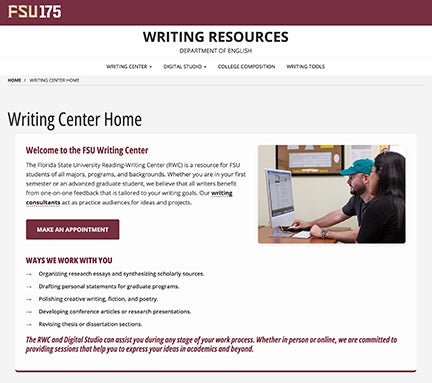
Students who attend the RWC-DS in-person will encounter a newly restructured Digital Studio space and those who seek help online have access to an updated writing resources website, featuring reference guides, drafting guides, and research tips, are both available.
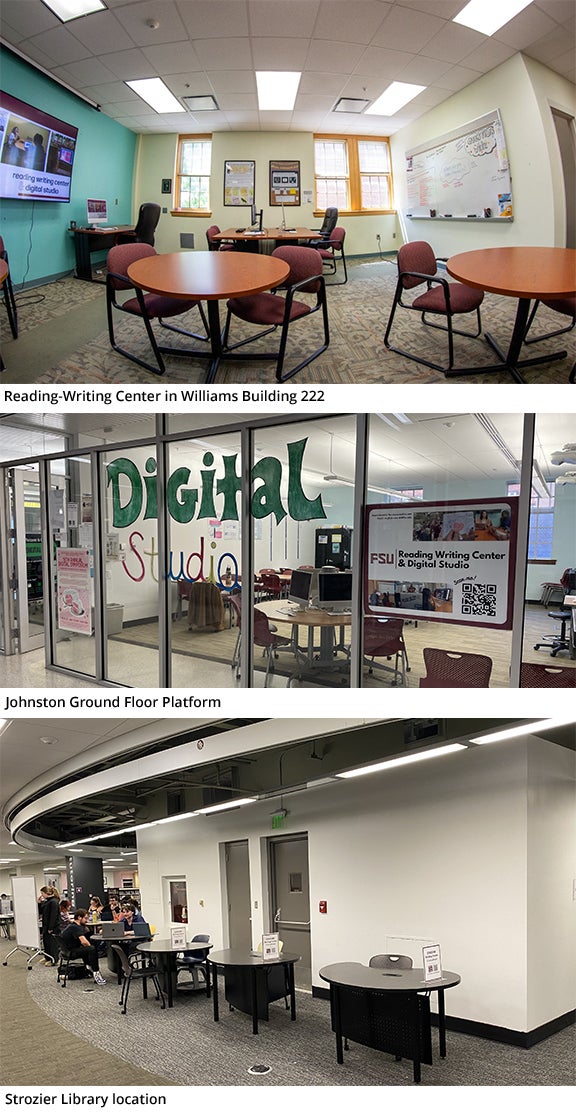 “We have restructured our Digital Studio to be the ‘Writing and Digital Studio,’ so instead of students having to meet in separate locations in WJB, both writing assignments and digital projects can be covered in WJB G062,” says Sophia Ziemer, a doctoral student in the Rhetoric and Composition Program and assistant director for the RWC-DS.
“You'll also find us at Market Wednesday a few times this semester, so keep an eye out for that,” Ziemer mentions.
Former English Professor Marian Bashinski founded the Reading Writing Center on FSU’s campus in the 1960s, and the services have been a staple for students of every skill set since. With locations in the Williams Building, the William-Johnston Building, and Strozier Library, assistance is conveniently available.
RWC-DS Director Kamila Albert, a specialized faculty member in the English department, is entering her sixth year in that role and says she has seen many changes throughout her time, although “the heart of our practices has stayed the same.”
“Because our mission is focused on supporting students, our team—the undergraduate and graduate students who work in the RWC-DS—grow as teachers and communicators in important ways,” she adds.
Working one-on-one with students allows consultants to tailor the feedback and discussion to the students’ goals and writing assignments that range from their first college-level research papers to creative writing pieces to thesis sections. Consultants can also work with graduate students on their dissertations.
Albert mentions that a misconception is that the RWC-DS is available only for quick feedback. Consultants help students brainstorm, visualize plans through whiteboards and sticky notes, and curate new ideas or sources.
“We demystify aspects of writing as a solitary process or an easy process for some people,” Albert explains. “Trust us—ask the capstone and dissertation writers on our staff if working on their projects is easy. None of them will say yes. Writing is hard. All writers, even the most experienced and award-winning scholars, get feedback from peers, reviewers, and editors.”
Writing consultants at the three locations across campus are FSU graduate students and trained undergraduates, and they specialize in all areas of the writing and designing process.
Mekenzie McElroy is a coordinator for the Digital Studio and a doctoral student in FSU’s Rhetoric and Composition Program. She admits that working in the center and taking graduate classes is a balancing act, but she enjoys working with students from other academic disciplines and seeing their progress throughout a semester, as well as leading workshops.
We demystify aspects of writing as a solitary process or an easy process for some people. . . .Writing is hard. All writers, even the most experienced and award-winning scholars, get feedback from peers, reviewers, and editors.
— Kamila Albert
The Digital Studio is in the William-Johnston Building, and staff at that location provide guidance to students on digital projects, such as e-portfolios, video editing, or designing research posters. The Studio also has a poster-printing service, and students are given access to one free poster per semester, for events such as an academic conference or any university-related research presentation
“We also work on verbal and visual presentations or public speaking,” Ziemer says.
Additionally, the Digital Studio offers workshops focused on ePortfolios, graphic design, and poster making. Digital Studio workshops guide students on how to complete projects other than a traditional essay or paper, such as building websites or using layout design platforms, and the work becomes a fun way to show what the RWC-DS offers, McElroy shares.
“Writing and Editing for Print and Online courses have a major assignment, producing a magazine spread, so we talk about document design, going through Canva, and also InDesign because our computers have access to the Adobe Creative Cloud,” McElroy explains.
The RWC-DS staff is comprised of graduate and undergraduate students. Graduate students are from the English department and take a 3-credit writing center studies course that teaches them how to work with writers from across disciplines. Albert also recruits undergraduates who have taken ENC 3493, a 3-credit experiential learning course which prepares students for the work. Any student from any major is welcome to sign up for ENC 3493.
“The courses introduce them to writing center studies, which is a rich, supportive research and professional community that publishes scholarship and holds conferences year-round,” she adds.
The use of artificial intelligence in the classroom and for coursework are a common issue and topic, and Albert says consultants are trained about generative AI tools.
“Many students come to us with questions about genAI policies within their classes since the policies—ranging from prohibited to encouraged—can vary widely even within departments,” she says. “Because of that, we will always ask for the assignment prompt to view the instructor’s policy before proceeding. If students, particularly first- and second-year students, are using AI, we want to ensure they are using it in critical, informed, and responsible ways that do not offload learning skills.”
Consultants also work with writers on scholarly articles and conference papers.
“Many academic journals have generative AI policies now, so the same review for AI applies for advanced scholarly writing,” Albert explains. “We have a page on our website called Views on AI Writing Tools that RWC-DS administrators co-wrote and revise regularly."
The Williams Building RWC is open in Room 222 from 10 a.m. to 4 p.m., Monday through Thursday, and 10 a.m. to 2 p.m. on Fridays.
The William-Johnston location is open from 10 a.m. to 4 p.m., Monday through Thursday. To find Room G062, the north side entrance into the building is the easiest, from the sidewalk between Landis Green and Reynolds Hall.
Strozier Library’s RWC is available from 4 p.m. to 8 p.m., Monday through Thursday. The William-Johnston and Strozier Library locations are both closed on Friday.
The RWC and DS are also available to FSU alumni for up to one year after graduation, if their FSU email address is still active. Consultants are available to help fine tune application documents for jobs, graduate school, law school, or medical school, Ziemer adds.
Ziemer mentions three points for students to keep in mind: the center and studio are not for “bad” writers and is open to all stages and levels of writers; appointments are recommended but not required; and consultants can help with non-academic writing and other genres, not strictly English papers.
Walk-ins are welcome, although Ziemer recommends that students book an appointment through the website if they require one-on-one help.
Olivia Hayes is a double major in English-Editing, Writing, Media, and in media communication studies.
Follow the English department: Instagram; Facebook; LinkedIn; X.