
Williams Building and the Dodd Hall basement evoke eeriness and superstitions for English department community members
By Isabella Salas-Lee
The days of late October can call to mind certain superstitions or create eerie moments: black cats, jack ‘o’ lanterns, or walking through a graveyard, to name a few.
Many landmarks on the Florida State University campus likely have such stories to reveal. One of FSU’s most famous rituals goes back to 1962: the creation of the football team’s sod cemetery.
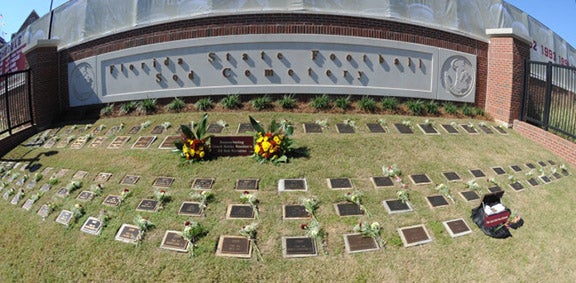
After an away football game on Oct. 20 against the heavily favored Georgia Bulldogs, which FSU won, one of the team’s captains ripped up a piece of stadium’s grass field and brought it back to Tallahassee.
Then-head football coach Bill Peterson buried the sod on the practice field, implementing a custom to motivate players then and in the future. He and university officials eventually built gravestones to bury mounds of sod from future road victories that qualify as “sod games.”
Today, as you walk past the field of 114 graves located next to Doak Campbell Stadium, the feeling is a bit ominous when the only demise was the pride of a sports opponent.
* * *
A superstition—according to the Cambridge Dictionary—is “a belief not based on reason or science, but unrelated events whether good or bad.”
The sod cemetery is one of numerous superstition-type stories found on campus; students in the Department of English have their own stories to tell.
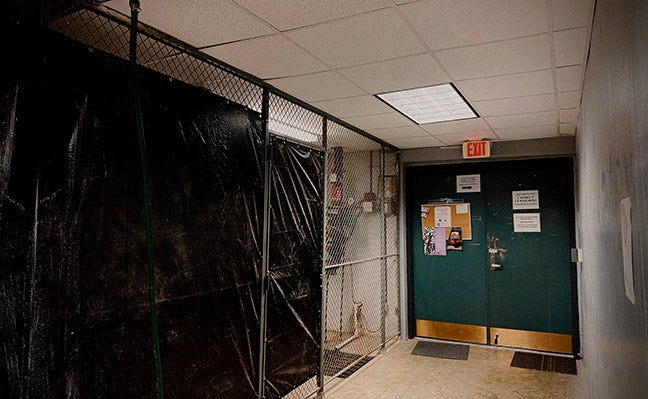
Three graduate students share one in particular: the Dodd Hall basement, where many teaching assistants are assigned an office.
“I hated the basement,” says Fernanda Coutinho Teixeira, a doctoral candidate in Creative Writing-Fiction. “Some people love it. Some people spend a lot of time there, but I just hated it. All that concrete vibe and the space felt so claustrophobic. So, I never spent time there.”
Heather Truett, a doctoral candidate in Creative Writing-Fiction and editor in chief of Southeast Review, the graduate student-run national literary magazine, feels for students being stuck in a Dodd office.
“If you're a master’s student, you never get to leave Dodd basement,” Truett says. “There’s always water dripping somewhere, but you can’t see water. They replaced the carpet last year, but it still smells like damp carpet.”
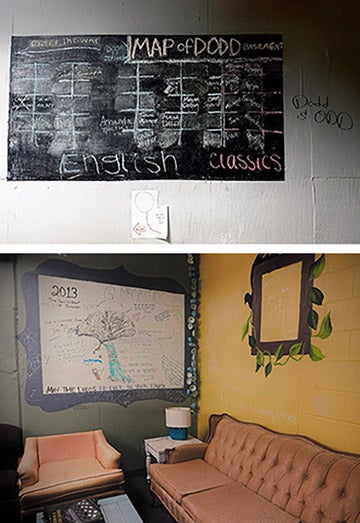
Dodd Hall was constructed in 1923 making it one of the oldest buildings on campus. Originally called the Florida State College for Women Library, the building was renamed in 1961 to honor former College of Arts and Sciences Dean William George Dodd, who joined the faculty in 1910 as an English professor, forever linking his legacy to the English department.
The building, with its Collegiate Gothic architecture and old-world structure, catches the eye of every tour group. Below the interior rooms decorated with stained glass and wooden arches, the English department’s graduate cohort is housed each semester.
Connor Devore, a master’s student in Creative Writing-Poetry, shares that the basement atmosphere enhances his superstitious nature when it comes to writing or hanging out there.
“I've tried working down here before, and it just doesn't work for me at all—the office feels so oppressive,” Devore says. “I guess all the concrete and the art makes the area feel very bureaucratic.”
Devore even goes so far as to describe the eerie mood as working with the souls of deceased bureaucrats over his head.
“Graduate students aren’t bureaucrats, but we are sort of government employees,” he adds. “There’s an element of that.”
* * *
The Williams Building was built in 1926 and underwent renovation in the 1960s to install air conditioning. The interior courtyard, known previously as “The Well,” was modified, giving the building more floor space. However, certain window areas were sacrificed, which made the hallways feel cramped.
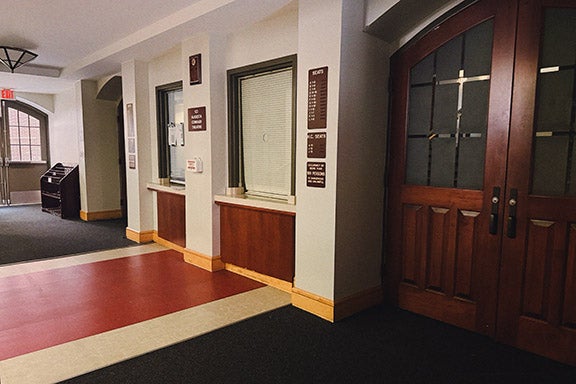
Linda Saladin-Adams, an FSU English professor for many years, told English-Editing, Writing, and Media alumna Priscilla Lauture in 2013 for an article that she believed Williams had an ominous atmosphere due to the scarcity of windows at the time. Saladin-Adams also described the lights often flickering off and on at random times.
At one time, the building had half floors that allowed the elevators to visit different levels so workers could install heating equipment or do other maintenance. There were two openings in the elevators, facing north and east.
“Every once in a while, the elevator would open the wrong way, to a brick wall, which was always unsettling,” Saladin-Adams said. “The building is haunted.”
The Williams Building once housed four other departments in addition to English: classics, humanities, speech, and the Northwest Regional Data Center.
Daisy Flory Parker Professor Emeritus of English Fred Standley taught at FSU for 50 years until his retirement in 2013 and served as department chair from 1973 to 1982, and again from 1997 to 1999. He joked to Lauture about how complex the Williams Building was to navigate.
“If you found your way into the Williams Building, make sure you don’t do it in the dark because doing it in the daylight was bad enough,” Standley said. “Taking a ball of string with you can help you find your way back out. If you’re there at night, you need to take a ball of string and candles and a flashlight.”
In the present day, Devore says he feels uneasy using the staircase on the west side of the building and would rather use the elevators.
“If you take those stairs up to the fourth floor, you enter this kind of weird cubby area where several professors have offices,” he says. “I don’t like going that way. I always take one of the elevators up.”
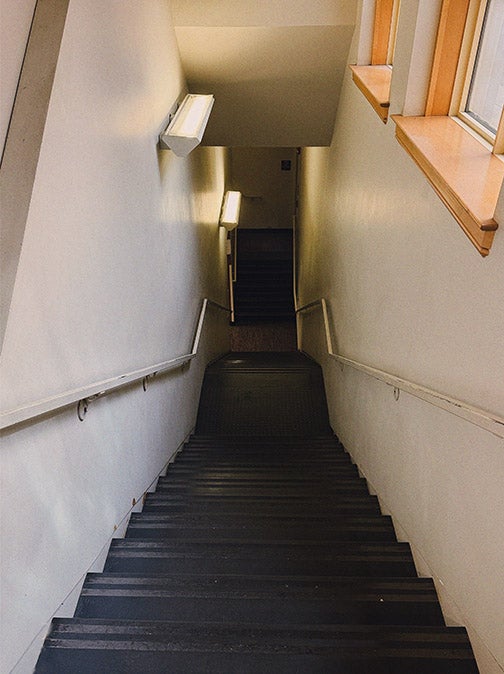
The central staircase section from the first floor to the ground floor carries its own dim and nerve-racking sense of dread, as anyone who has walked down the stairs at night knows.
* * *
Various superstitions affect the writing rituals of some students. Teixeira shares one that creeps into her thought process.
“I've heard the idea that you should not talk about an idea as you’re writing it because if you talk about it, you're just gonna lose the juice to keep going with it,” she says. “I do have some of that, and I don’t like talking about ongoing drafts or sharing them because I feel like I need at least one bad complete draft before I show it to someone else.”
Teixeira admits that she scared easily when she was a child, so she now sometimes writes about ideas and memories that scare her.
“I have a story about a haunted house that is directly based on this house that was at the end of my street that creeped me out,” she says. “Nobody lived there. The house was empty, and nothing was wrong with it. It was just old, but to me that was very startling and scared me. In general, I think what brings you fear is easier to make fearful on the page.”
Truett says she has no specific writing rituals.
“You can't be precious about writing; it just has to get done like any other task,” she adds.
She did pick up a tradition involving tarot cards at a recent writing retreat, however.
“I bought a special deck of tarot cards because every card is about bees, and my dissertation has magic bees in it,” she explains. “So, I pulled a card before every morning writing session and thought about how that card related to my story.”
Teixeira says her rituals usually relate to her family. While not specifically connected to writing, her great aunt warned her about throwing her shoes around.
“Don’t leave your shoes turned over because that allegedly attracts death,” she says. “To this day, I don’t leave my shoes around. I’m uncomfortable if they’re not straight.”
* * *
Whether it’s burying a piece of sod, breaking out the tarot cards, or keeping your shoes tidy, FSU community members are susceptible to the strange and unsettling. Despite some feelings of spookiness, the Williams Building and Dodd Hall basement continue to allow writers to thrive under the guise of its precautions.
Isabella Salas-Lee is a major in English-Creative Writing.
Follow the English department: Instagram; Facebook; LinkedIn; X.