
Creative Writing alumna Michelle Flores is crafting her life story and teaching high school students to love reading and literature
By Bianca Aguirre
Upon arriving at Florida State University for her undergraduate studies, Michelle Flores was undecided between majoring in English or anthropology. She signed up for her first poetry workshop in 2006.
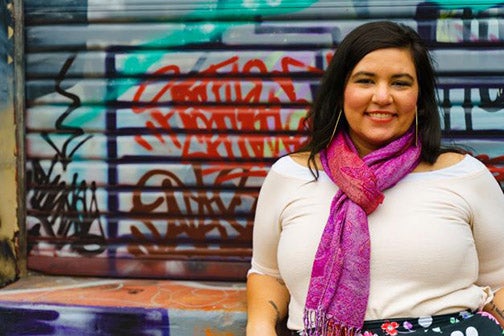
Flores had little idea what a creative writing classroom might look like until she enrolled in English Professor James Kimbrell’s course.
“Seeing people take one poem so seriously that you dedicate a whole class period to it was so mind-boggling for me,” she says.
That experience turned Flores’ interest in writing into her main focus. She became an English-Creative Writing major, certain that writing was her new academic pursuit.
Now, 17 years after her graduation from FSU, Flores teaches young students as the creative writing department chair at Douglas Anderson School of the Arts in Jacksonville. She also continues to work as a writer and performer herself.
When she graduated from FSU in 2009, however, her path to get there was not entirely clear. Flores finished her undergraduate studies in the middle of a recession; she chose to continue her education at New York University, where she earned a Master of Fine Arts in creative writing.
She knew she wanted writing to be part of her life, but she also had to think realistically about what that choice for a career might mean.
“I knew that I wanted to stay within writing, but I also wanted health insurance,” Flores says.
She originally planned to go into academia, potentially to become a professor. Yet, that plan shifted when she began to work in the New York City public school system as an in-class tutor. Flores found the work to be meaningful, and she realized how much she enjoyed being in the classroom.
“That’s when I sort of fell into teaching,” Flores says. “It wasn’t something I necessarily planned.”
The experience in New York eventually led Flores to join Teach for America, a nonprofit organization that works in low-income or under-resourced public and charter schools. In 2011, she was placed in Memphis, Tennessee, and Flores describes the next two years as some of the most difficult of her teaching career, but the school gave her significant freedom over what and how she taught.
“I really focused on getting kids to love reading and to just love literature,” Flores says.
Rather than structuring lessons around test preparation, Flores had a more creative and interactive classroom environment. Flores wanted her students to become comfortable spending time with books and finding stories they enjoyed.
She combined contemporary books such as The Hunger Games and Percy Jackson with more traditional texts, such as Lord of the Flies and ancient Greek mythology.
“It was such a fun experience to take this modern pop culture literature and then combine it with some of the classic, more traditional curriculum,” Flores says.
She also incorporated creative projects throughout her classes, asking students to write poetry, original songs, and even create their own mythologies. Those assignments inspired early ideas of the kind of classroom Flores hoped to have one day.
“I thought, ‘Wow, it would be so cool if one day I could do this, but all the students do is create original work,’” Flores says.
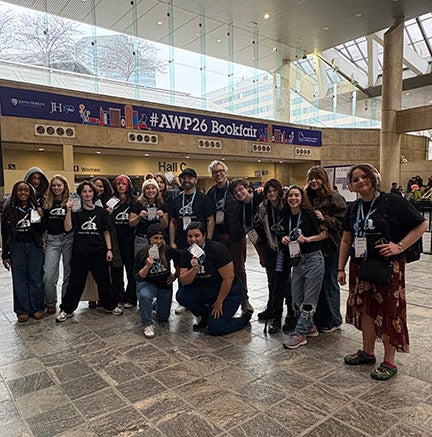
When a teaching spot at Douglas Anderson opened four years ago, Flores took the opportunity. Douglas Anderson School of the Arts is a magnet Jacksonville public high school, where students receive specialized instruction in arts-focused disciplines. For Flores, the position offered a chance to immerse herself and her students in the artistic environment she had imagined while teaching in Memphis.
“I basically got all the teaching fundamentals I needed through Teach for America,” Flores says, “and now I’m back into this more artistic world that I originally came from.”
According to its website, the school opened in 1922 as The South Jacksonville School, to serve the area's African American students. The original name was changed in 1945 to honor a local civil rights activist, Douglas Anderson, and it was established as an arts school in 1985.
As the school’s creative writing department chair, Flores wears many hats. She teaches six different courses, including poetry workshops, speech, publishing, digital media, dual enrollment, and a portfolio course focused on the professional side of being a writer.
She is also the school librarian and organizes events such as a quarterly open mic series, an annual guest artist day, and Coffee House, a showcase made up entirely of original student work.
“It doesn't feel the way it felt when I was a traditional English teacher,” Flores says. “This just feels much closer to my personal beliefs and mission.”
Additionally, Flores is the advisor for Élan, Douglas Anderson’s student-run literary magazine, which gives students hands-on experience with the publishing side of writing. Élan predates Douglas Anderson’s creative writing department, Flores explains, and played a role in the program’s creation.
“Because of Élan, creative writing became a major,” she says. “So many students were interested in submitting work and learning about publishing and writing beyond just writing for a prompt, but writing as an art form.”
For her, one of the most rewarding aspects of her advisor role is seeing her students curate and create a space for other young writers from around the world.
That perspective and her teaching philosophy earned Flores recognition as a top-five finalist for the 2026 Vystar Duval County Public Schools Teacher of the Year. Vice President of the Jacksonville Public Education Fund Ronetta Wards and Duval County School Board member Cindy Pearson surprised Flores with the announcement during a December 2025 visit to her classroom.
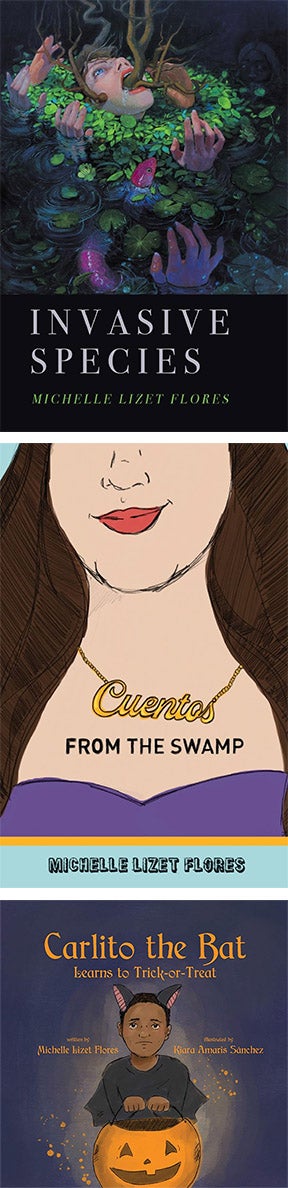
Even though teaching takes much of her time, Flores has continued to publish and participate in the literary world herself. She has published Memoria, the winner of the 2019 Get Like Us Chapbook Prize, a children’s book, Carlito the Bat Learns to Trick or Treat, and a collection of poems, Cuentos from the Swamp.
Her most recent full-length collection of poetry, Invasive Species, was published in early February 2024. Author, poetry editor, and reader for literary journals Andres Rojas wrote in his review, "Mixing magic and street smarts as easily as English and Spanish, Michelle Lizet Flores gifts us with an intimate but unflinching exploration of the self and the many pasts that shape it. Her Cuban roots and female ancestors imbue her American life and children with a dense, palpable other-worldliness we are the richer for.”
Flores' experiences as a writer have influenced her approach to teaching, as well. Flores considers the ways she has secured speaking opportunities, published her own work, and built a professional presence, and she uses those successes to shape the skills she teaches to her students.
She thinks about what young writers need to learn beyond simply producing excellent work.
“I don’t ever ask my students to do anything that I would not do,” Flores says.
Flores says her experiences help students take her classroom lessons more seriously because they see her doing work in the publishing world to further her own career.
“They know if I'm asking them to do something, it's because I've already done it myself,” Flores says. “If you want to be a writer, these are the steps you have to take to get there.”
Flores says much of what she learned at FSU has guided her career and her teaching, noting that the most significant was being in Robert O. Lawton Distinguished Professor of English David Kirby’s workshop.
“Michell’s poems are rich with the flora of Florida life — guava, mamey, banyan trees, bougainvillea — and richer still with people,” Kirby says. “In those poems you’ll meet friends, lovers, old folks, and, mainly, Michelle herself. You really feel as though you’re talking face to face with someone when you read these.”
Flores remembers the positive, constructive environment in Kirby’s workshop, and she tries to create that same atmosphere for her own students. The goal of a workshop is not to tear apart someone’s work, she explains, but to help the writer see where it can go next.
“When a workshop is done well and when the culture is right, you feel like you're just getting advice from friends,” Flores says. “This is their idea; this is the concept they have. How do we enhance it and make it stronger for the next round of revisions?”
Years after Flores was a student in Kirby’s workshop, the connection between the two became more personal when he visited Douglas Anderson to teach Flores’ students.
“Dr. Kirby came to my campus and taught my students, which is just a really special moment,” Flores says.
Kirby describes Flores as “the best kind of teacher.”
“She models what it’s like to be joyful in life and work, and that makes her students feel the same way,” he adds.
Looking back on her own time spent primarily in FSU’s Williams Building, Flores says she once worried that she was developing more slowly as a writer than some of her peers. If she could speak to that younger version of herself now, though, her advice would be simple.
“It doesn’t matter how long it takes if you stick with it,” Flores says. “You’re gonna live some life. You’re gonna have some fun stories. And you’re gonna create some weird stuff based off all that.”
Flores’ path, from discovering poetry in college to helping young writers discover their own voices, may not have unfolded the way she imagined. But each step eventually returned her to the type of classroom where it all began, the one where she realized what she wanted to do with her life.
Bianca Aguirre is a double major in English-Editing, Writing, and Media and in media communication studies.
Follow the English department: Instagram; Facebook; LinkedIn; X.